
Opinion
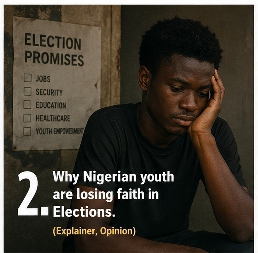
In recent years, there has been a growing sense of disillusionment among Nigerian youths regarding the electoral process. This disenchantment stems from various factors, including electoral malpractices, poor governance, and an ineffective political system. This loss of faith is not only a reflection of the youths’ dissatisfaction with the political status quo, but also a consequence of their diminished belief in the transformative power of elections.
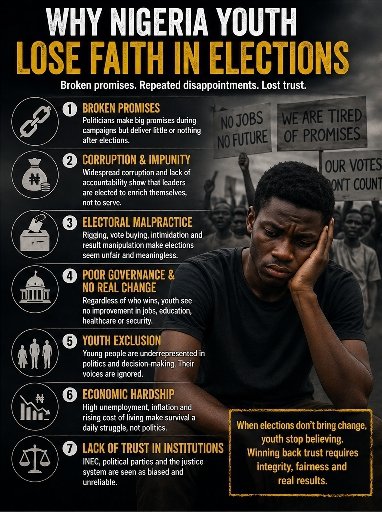
ELECTORAL MALPRACTICES AND LACK OF TRANSPARENCY
One of the major reasons why Nigerian youths are losing faith in elections is the widespread belief that their votes do not matter. Allegations of election rigging, vote-buying, and manipulation have undermined the legitimacy of the electoral system. The Independent National Electoral Commission (INEC), which is responsible for conducting elections, has been criticized for its inability to ensure a transparent and credible process. These persistent accusations of electoral fraud contribute to the perception that no matter how many people vote, the outcome is often predetermined by the powers that be. This lack of trust in the integrity of the election process has caused many young Nigerians to question the value of their vote.
ELECTION VIOLENCE AND INSECURITY
Another factor that has deterred youth participation in elections is the rampant violence and insecurity that often accompany the electoral process. Election-related violence, including ballot snatching, intimidation, and attacks on polling agents and voters, makes many young people fear for their safety. When youths are faced with the prospect of being targeted for political violence, they understandably choose to disengage from the political process. In regions where security forces are either absent or complicit, the absence of a safe environment for voting further discourages participation.
MONEY POLITICS AND VOTE-BUYING
The commercialization of politics in Nigeria, characterized by money politics and vote-buying, has also eroded the credibility of elections. Political elites often use financial incentives to sway voters, turning the election process into a business transaction rather than a contest of ideas and policies. This practice not only compromises the integrity of elections but also makes it seem as though the outcome is determined by the highest bidder rather than the people’s will. This undermines the democratic principle of free and fair elections and leads to a situation where many youths feel that their voices are meaningless in the political arena.
LACK OF YOUTH REPRESENTATION AND INTERNAL PARTY DEMOCRACY
Despite constituting a significant portion of Nigeria’s population, young people are poorly represented in the political process. Internal party politics often exclude young aspirants from emerging as candidates for elected positions. Older, established politicians dominate the political space, and party structures are frequently controlled by elites with vested interests. This lack of opportunity for young people to contest and win elections further exacerbates the belief that the political system is not inclusive. Many youths feel that their interests are not being represented by the candidates on offer, further fueling their disillusionment with the electoral process.
UNFULFILLED CAMPAIGN PROMISES AND POOR GOVERNANCE
Political campaigns in Nigeria are often characterized by lofty promises and pledges that are never fulfilled once candidates are elected. Nigerian youth, who are facing high unemployment rates, poor infrastructure, and inadequate education systems, are particularly vulnerable to these unkept promises. As these issues persist without meaningful solutions, young people become increasingly skeptical of the ability of elections to bring about real change. The failure of politicians to address the pressing needs of the youth exacerbates feelings of disenfranchisement and hopelessness.
SLOW JUSTICE SYSTEM ON ELECTORAL OFFENSES
The slow pace of justice in addressing electoral offenses is another factor contributing to the loss of faith in the electoral system. When election-related crimes such as voter suppression, ballot box tampering, and violence go unpunished, it sends a message that the system is broken and that there are no real consequences for wrongdoing. The lack of timely prosecution of electoral offenders leaves many youths believing that the political system is rigged in favor of powerful elites, further diminishing their confidence in the electoral process.
CONCLUSION
In conclusion, the loss of faith in elections among Nigerian youth is the result of a combination of factors, including electoral malpractices, violence, money politics, poor governance, and a lack of youth representation. These issues have created a situation where many young Nigerians feel that elections are not a true reflection of the people’s will, but rather a process controlled by elites with little regard for the interests of the majority. Unless there is a concerted effort to reform the political system, ensure
