
AN OPINION
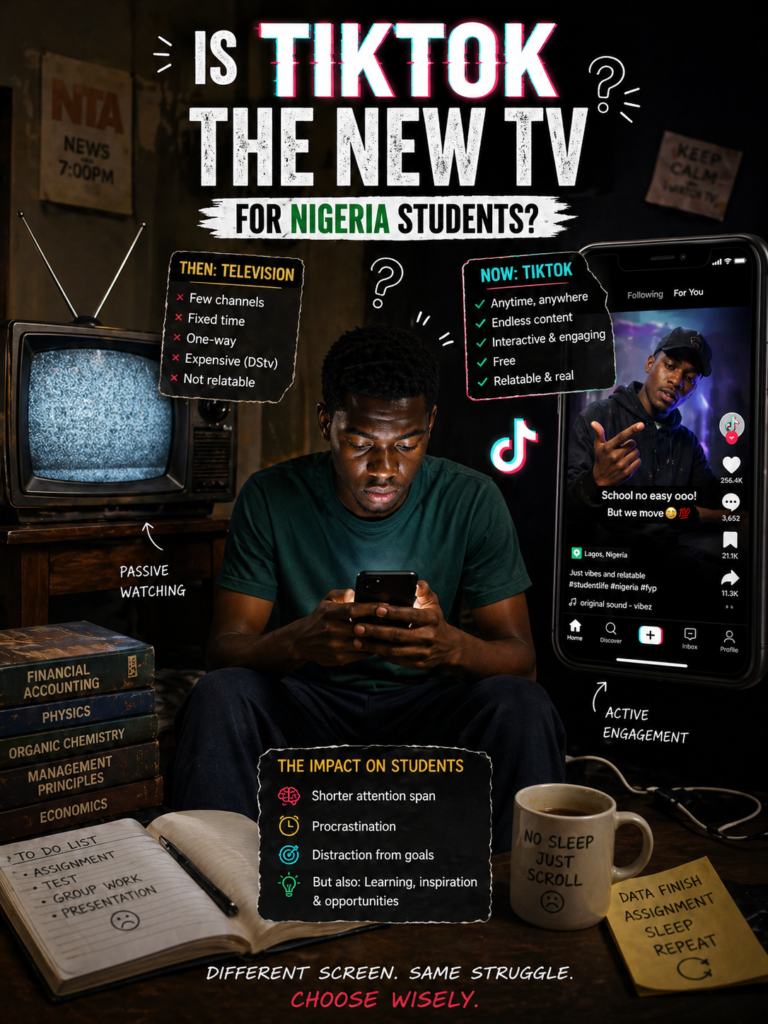
For many Nigerian students today, the television set is no longer the center of entertainment. Instead, attention has shifted to smartphones, where TikTok delivers an endless stream of short videos tailored to individual preferences
When the power went out in the hostel common room, no one complained. It wasn’t because students had suddenly become patient with Nigeria’s electricity situation it was because no one was watching television.
Instead, the room remained quietly lit by the glow of phone screens. Fingers scrolled endlessly. Laughter came in short bursts. Someone shouted, “Check this TikTok!” and within seconds, three others were watching the same video, heads bent over a single screen.
“I can stay on this app for hours,” said Daniel, a 200-level student. “TV is boring now. Everything is on TikTok news, jokes, even things I didn’t know I needed.
”Across Nigerian campuses, this scene is becoming normal. Television, once the centre of shared entertainment and information, is slowly fading into the background. In its place, TikTok has taken over not just as an app, but as a daily habit shaping how students think, interact, and understand the world.
The attraction is obvious. TikTok is fast, personal, and interactive. Unlike television, where viewers passively receive content, students on TikTok are part of the experience. They create videos, comment, remix trends, and influence what others see. The platform learns what users like and serves it back to them in an endless loop.
For many, it feels empowering. But beneath the excitement, there is a growing concern that few are willing to confront.
“I went online to watch one video,” another student admitted, laughing. “Before I knew it, two hours had passed. I didn’t even touch my books.
”This is where the problem begins not just with distraction, but with the kind of content being consumed. Unlike traditional television, where programmes go through layers of editing and verification, TikTok allows anyone to post anything. Facts and opinions often look the same. Entertainment and misinformation move at the same speed.
During major national conversations, misleading videos spread quickly, sometimes shaping opinions before the truth catches up. Yet many students rarely stop to question what they watch.
The responsibility does not rest on students alone. TikTok is designed to keep users engaged for as long as possible, pushing content that triggers emotion whether accurate or not. Regulatory bodies have struggled to keep pace with the speed of digital media, leaving gaps in oversight. Universities, too, have focused more on academic content than on teaching students how to navigate the media they consume daily.
The result is a generation that is highly connected, but not always critically aware.
Still, not everyone sees TikTok as a problem. Some students use it to learn new skills, promote small businesses, and stay informed in ways television never allowed. For them, the platform represents opportunity, not danger.
And that is where the conversation becomes complicated.
TikTok is not simply replacing television; it is redefining what media means for young people. It has turned viewers into participants, shortened attention spans, and blurred the line between information and entertainment.
Back in the hostel, the power eventually returned. The television flickered on, playing a news broadcast to an empty room. No one looked up.
The phones, however, never went dark.
So the question is no longer whether TikTok is the new television for Nigerian students. It is whether this new “television” is informing them, distracting them, or quietly reshaping a generation without anyone truly paying attention..
