
By Adebayo precious Damilola, Omotoso Isaac Ayodeji, Fele Aanuoluwapo Rukayat.
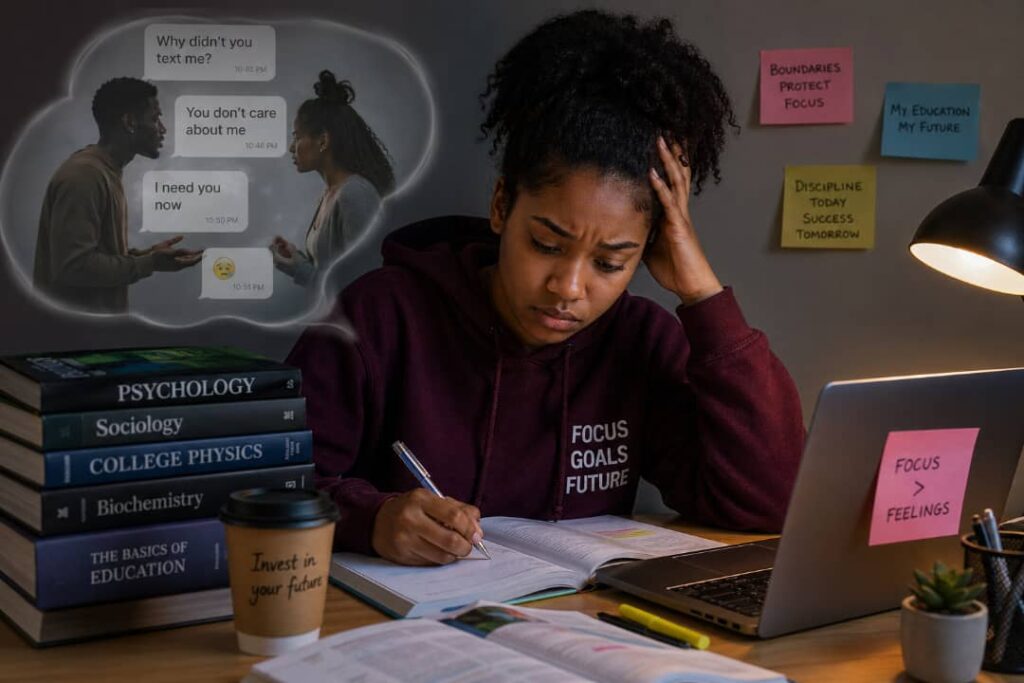
College and secondary school years are often described as a time of discovery — discovering your purpose, your strengths, your future career path, and very often, romantic relationships. While relationships can be a source of motivation, emotional support, and happiness, they can also become a major source of stress. When relationship tension rises, academic focus often drops. Many students experience this conflict but rarely talk openly about it.
This raises an important question: How exactly does relationship stress affect academic performance, and what can students do about it?
Relationships demand emotional energy. When things are going well, that energy can feel uplifting and inspiring. But when conflicts, misunderstandings, jealousy, distance, or breakups occur, the emotional toll can be heavy. Students dealing with relationship stress often report; Difficulty concentrating in class, Loss of motivation to study, Sleep problems, Anxiety and overthinking, Constant phone checking during lectures, Reduced participation in academic activities.
Emotional distress competes with mental attention. The brain struggles to focus on assignments when it is busy processing emotional pain.
One major way relationship stress harms academic focus is through constant distraction. Students may find themselves rereading the same page repeatedly without understanding it. Group projects suffer when someone is mentally absent. Even during exams, unresolved emotional conflict can interrupt thinking patterns.
Digital communication makes this worse. Messaging apps and social media keep relationship issues active all day long. A single upsetting text can derail an entire study session.
Not all relationship stress comes from conflict. Sometimes, even caring relationships can unintentionally create pressure. For example; A partner demanding too much time, Feeling guilty for studying instead of spending time together, Pressure to always be available online, Emotional dependence that limits personal growth.
In such cases, students may sacrifice academic time to maintain relationship harmony. Healthy relationships support academic goals. Unbalanced relationships compete with them.
Breakups are among the most emotionally disruptive experiences for students. Research and student counselling reports consistently show that academic performance often drops after a breakup. Students may experience; grade decline, Missed deadlines, Class absenteeism, social withdrawal. The grief process affects cognitive performance — memory, attention, and decision-making all suffer temporarily. However, recovery is possible, and many students regain stronger focus after emotional healing.
Students should watch for these signals; You study but retain nothing, your grades drop unexpectedly, You feel emotionally drained daily, You avoid schoolwork to deal with relationship issues, Your mood depends entirely on your partner’s behaviour, You lose interest in goals you once cared about. Recognizing the signs early allows you to take corrective action.
Students don’t have to choose between love and learning — but they must create boundaries. Here are effective strategies:
1. Set Time Boundaries:
Create specific study hours where relationship communication is paused. Silence notifications if needed.
2. Communicate Academic Priorities:
Explain your academic goals to your partner. A supportive partner will respect your study time.
3. Use Structured Study Methods:
Timed study sessions (like the 50–10 method: 50 minutes study, 10 minutes break) help rebuild concentration.
4. Seek Support:
Talk to a counsellor, mentor, or trusted friend when emotional stress becomes overwhelming.
5. Maintain Personal Identity:
Do not let a relationship replace your personal goals, hobbies, and ambitions.
6. Practice Emotional Regulation:
Journaling, exercise, and mindfulness techniques help stabilize emotions and improve mental clarity.
Relationships are an important part of student life, but they should not consume it. Education builds long-term stability and opportunity. A healthy relationship should strengthen your academic journey — not weaken it. Students who learn to balance emotional life with academic responsibility develop stronger discipline, better communication skills, and greater emotional intelligence.
Love can be powerful but so is your future. When relationship stress begins to cloud your academic focus, it is not a sign of failure. It is a signal to pause, reassess, and rebalance. The goal is not to avoid relationships, but to build ones that grow alongside your educational success, not against it.
