
NEWS
INTRODUCTION
The academic grading system in Nigeria evaluates student performance across different levels of education, from primary school through university. It uses a mix of letter grades, percentages, and point scales to measure achievement. These systems help determine promotion, graduation, and opportunities like university admission. While variations exist between institutions, national bodies like WAEC, NECO, and the National Universities Commission (NUC) provide standard frameworks.
PRIMARY AND JUNIOR SECONDARY EDUCATION
In primary and junior secondary schools, grading is often straightforward and percentage-based. Teachers assess students through continuous assessments, tests, and exams. Common letter grades include A (excellent, usually 70-100%), B (very good), C (credit/good), and lower grades down to F for fail. Many schools follow state ministry guidelines, with promotion requiring passing core subjects like English and Mathematics. The Junior Secondary Certificate Examination (JSCE) uses similar scales, emphasizing a minimum number of passes for progression to senior secondary.
SENIOR SECONDARY EDUCATION: WAEC AND NECO
The West African Senior School Certificate Examination (WASSCE) by WAEC and the Senior School Certificate Examination by NECO are crucial at the end of secondary school. They use a detailed letter-grade system based on percentages:A1: Excellent (75–100%)B2: Very Good (70–74%)B3: Good (65–69%)C4–C6: Credit (50–64%)D7–E8: Pass (40–49%)F9: Fail (0–39%)Credit passes (C6 and above) in key subjects, especially English and Mathematics, are required for university admission. JAMB (Unified Tertiary Matriculation Examination) complements this with its own scoring for placement.
UNIVERSITY GRADING SYSTEM
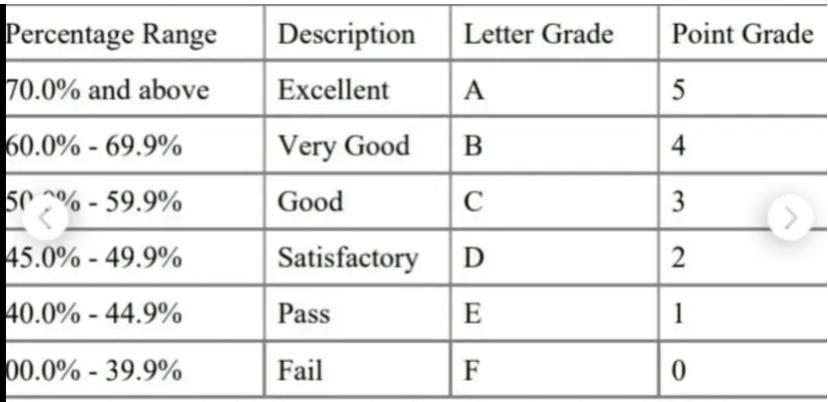
Nigerian universities primarily use a 5-point grading scale (some have shifted toward a 4-point system in line with NUC recommendations). Final grades combine continuous assessment (tests, assignments) and end-of-semester exams.Typical 5-Point Scale: A (70–100%): 5 points – Excellent B (60–69%): 4 points – Very Good C (50–59%): 3 points – Good D (45–49%): 2 points – Fair E (40–44%): 1 point – Pass F (0–39%): 0 points – FailPerformance is calculated as Grade Point Average (GPA) per semester and Cumulative Grade Point Average (CGPA) overall. CGPA determines the class of degree upon graduation.
DEGREE CLASSIFICATIONS (5-POINT SCALE)
First Class Honours: 4.50 – 5.00; Second Class Upper (2:1): 3.50 – 4.49; Second Class Lower (2:2): 2.40 – 3.49; Third Class: 1.50 – 2.39; Pass: Lower ranges (varies by institution). A 4-point scale, adopted by some universities, adjusts points (A=4, B=3, etc.) and classifications accordingly, with First Class starting at 3.50–4.00.
HOW GRADES ARE CALCULATED
Lecturers assign raw scores from various assessments, convert them to letter grades, and multiply by credit units for the course. GPA is the weighted average for the semester: (Sum of Grade Points × Credit Units) ÷ Total Credit Units. CGPA accumulates this across all semesters. Institutions publish clear rubrics in course handbooks.
IMPORTANCE AND CHALLENGES
Grading in Nigeria serves as a gateway to higher opportunities. Strong WAEC/NECO results and high JAMB scores boost admission chances, while a good CGPA opens doors to jobs, scholarships, and postgraduate studies. However, challenges like varying standards across schools, examination malpractices, and pressure on students remain topics of discussion. Some institutions are exploring reforms to emphasize skills alongside grades.Understanding Nigeria’s grading system helps students set realistic targets and prepare effectively. Whether in secondary school or university, consistent effort in assessments leads to better outcomes and brighter academic futures.
