
A NEWS
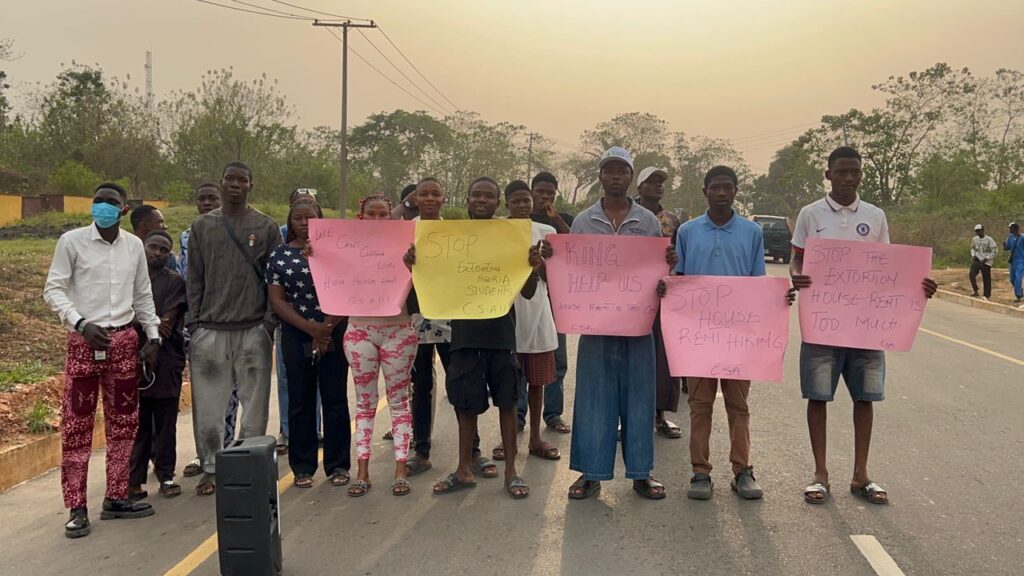
Tension boiled over in Ikere-Ekiti on Wednesday evening as students of Bamidele Olumilua University of Education, Science and Technology popularly known as BOUESTI poured into the streets to protest what they describe as exploitative and unbearable rent prices imposed by landlords in the university town.
The protest, which kicked off at 5 p.m. and was led by student activist Akinsara Favour alongside the Students’ Union Government (SUG), saw demonstrators block major roads across Ikere-Ekiti, demanding immediate intervention from local authorities and a halt to what students are calling systematic extortion.
At the heart of the grievance is a stark comparison that students say can no longer be ignored: some landlords are charging more for a single room than BOUESTI charges in school fees. For students already navigating the pressures of academic life in a difficult economy, the numbers simply do not add up.
How can we pay ₦800,000 for accommodation when our school fees are less than half of that? We are being extorted.
Students also raised concerns about the quality of accommodation being offered at these prices. Many argue that the facilities worn-out rooms with poor ventilation, inconsistent water supply, and little to no security do not justify the steep costs being demanded by landlords. The protest, they insist, is not just about money. It is about dignity.
The Ikere-Ekiti Landlords Association was quick to push back against what its Chairman, Chief Bayo Ogundele, called unfair blanket accusations. Speaking on behalf of property owners in the town, Ogundele acknowledged the frustration of students but argued that the rent increases are a direct response to Nigeria’s worsening economic greed.
Building materials have tripled in two years. Cement that was ₦3,500 is now over ₦10,000. We also pay for boreholes, security, waste disposal, and repairs after each set of tenants. Most of us took loans to build these hostels.
Ogundele was also keen to draw a distinction between the accommodation types being discussed. He clarified that the ₦800,000 figure applies to fully self-contained flats equipped with tiles, running water, and a steady electricity supply, not the standard single rooms that most students occupy, which he says still range between ₦120,000 and ₦250,000 depending on location and amenities Chief Ogundele invited the SUG to submit documented cases of overpriced or substandard housing to the Landlords Association for review, signalling a willingness to address legitimate complaints through dialogue rather than confrontation.
With tensions running high, traditional and institutional authorities have moved swiftly to prevent further escalation. The Ogoga of Ikere Kingdom, Oba Samuel Adejimi Adu Alagbado, has stepped in as a mediator between students and landlords a role that reflects the weight this crisis carries within the broader community.
In a significant policy shift, a new rent reduction framework has been introduced. The policy not only targets lower accommodation costs but also restructures the payment model moving from a per-academic-session billing system to annual rent payments, a change that could offer students more financial breathing room.
At the national level, the National Association of Nigerian Students (NANS) has added its voice to the chorus of condemnation, calling on relevant authorities to introduce binding regulations that shield students across the country from housing exploitation. NANS framed the Ikere-Ekiti situation not as an isolated incident but as a symptom of a wider, unregulated student housing crisis in Nigeria.
What is happening in Ikere-Ekiti is not unique. Students across Nigeria are being priced out of decent housing. It is time for the government to act.
As mediation continues, the outcome of negotiations between the SUG, the Landlords Association, and the palace of the Ogoga will be closely watched not just by BOUESTI students, but by student communities across Ekiti State and beyond. What happens next in Ikere-Ekiti may well set a precedent for how Nigeria handles the growing student housing crisis.
The Information Corner will continue to follow this story as it develops.
