
By BOUESTInewsline Desk
Lecturers in the Department of Communication Studies, Bamidele Olumilua University of Education, Science and Technology, Ikere-Ekiti (BOUESTI), have called for a deeper understanding of the role of digital platforms in reshaping democratic participation among Nigerian youths.
Dr. Obi, who led three other scholars in the study made this submission while presenting their paper titled “Digital Platforms and the Reconfiguration of Youth Political Participation in Nigeria’s Fourth Republic” at the Maiden Annual Conference of the College of Social and Management Sciences (COSMAS), BOUESTI.
Presenting findings from a systematic literature review anchored on the experiences of the #EndSARS and Obidient movements, Dr. Obi argued that digital platforms have evolved beyond mere communication tools into strategic infrastructures for political engagement, civic mobilization, and democratic participation.
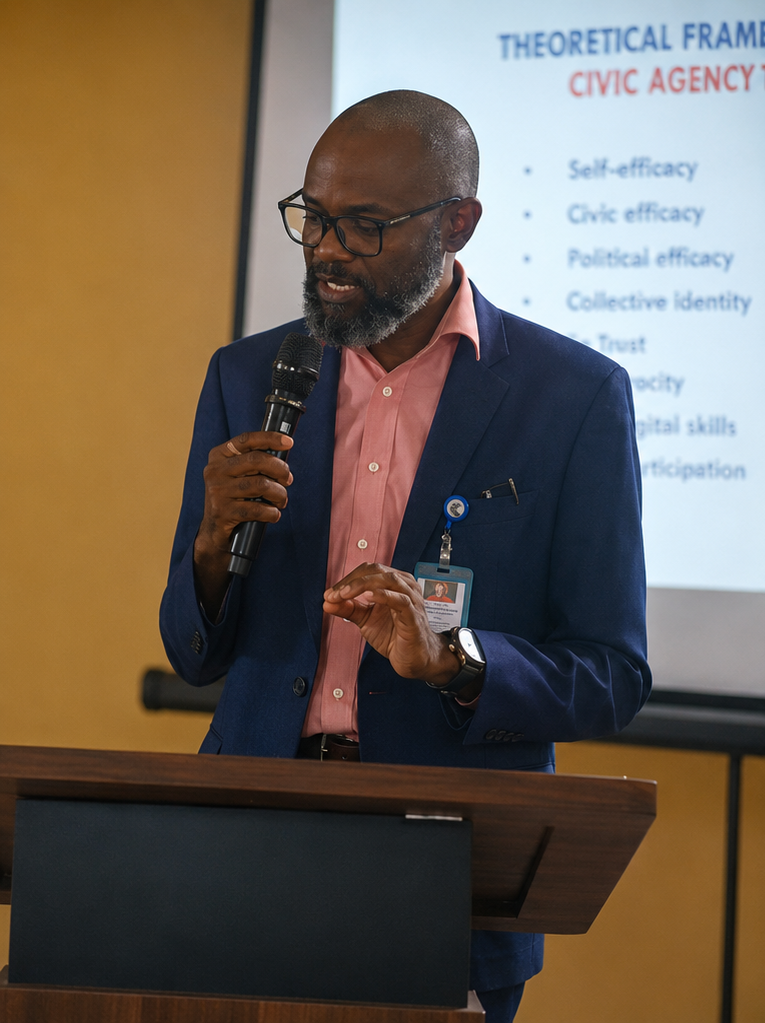
According to him, youth political participation in Nigeria has moved beyond conventional indicators such as voting, political party membership, and campaign rallies to include digital advocacy, citizen journalism, online deliberation, peer mobilization, crowdfunding, and collaborative agenda-setting.
He noted that digital platforms have significantly redistributed communicative power by weakening the exclusive gatekeeping role previously held by traditional media, political elites, and institutional actors.
“Digital platforms do not merely increase youth political participation; they fundamentally reconfigure its architecture,” he stated.
Dr. Obi further introduced a conceptual framework known as the Digital Reconfiguration Model (DRM) of Youth Political Participation, which explains how digital platforms create networked public spheres, strengthen civic agency, facilitate connective action, redistribute communicative power, and ultimately transform democratic participation.
The scholar, however, cautioned against technological determinism, stressing that digital democracy also presents risks such as misinformation, algorithmic bias, digital inequality, state surveillance, and the commercialization of political communication.
He recommended stronger digital literacy, inclusive digital infrastructure, responsible platform governance, and policies that protect civic engagement while combating disinformation.
Participants at the conference described the presentation as insightful, timely, and highly relevant to contemporary debates on youth participation, political communication, and democratic governance in Nigeria.
