
EXPLAINER
INTRODUCTION
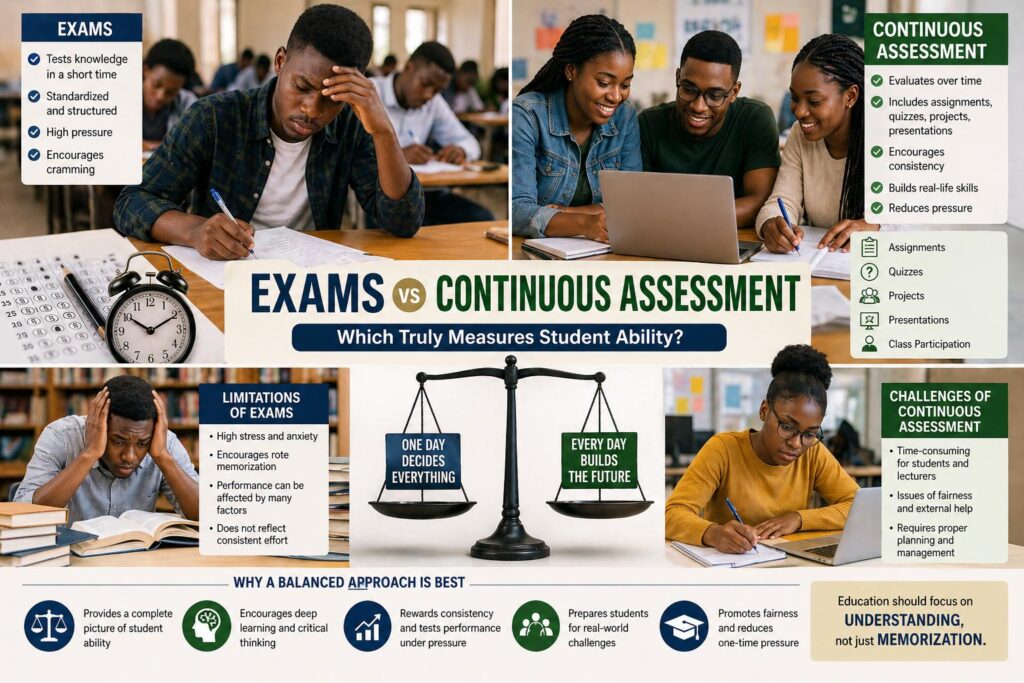
Assessment is a key part of the educational process, helping teachers measure students’ understanding, progress, and achievement. Among the most common assessment methods used in schools and higher institutions are examinations and continuous assessment. While both serve the purpose of evaluating learning, they differ in their approach, timing, and impact on students.
EXAMS AND CONTINUOUS ASSESSMENT
Examinations are formal tests conducted at specific periods, usually at the end of a term, semester, or academic session. They assess students’ knowledge within a limited timeframe and often contribute significantly to final grades. Continuous assessment, on the other hand, involves evaluating students throughout the learning process through assignments, quizzes, projects, presentations, class participation, and other academic activities. It provides a more ongoing measure of student performance and development.
COMPARISON OF THE TWO METHODS
Examinations offer a standardized way of assessing students and can be useful for measuring overall understanding of a subject. However, they may create pressure and may not fully capture a student’s abilities if performance is affected by stress or other factors. Continuous assessment encourages regular study habits and provides multiple opportunities for students to demonstrate their knowledge and skills. It also allows teachers to identify learning difficulties early. However, it can increase the workload for both students and teachers due to frequent tasks and evaluations.
BALANCING BOTH APPROACHES
Many educational institutions combine examinations and continuous assessment to achieve a more comprehensive evaluation of students. This approach ensures that learning is assessed both over time and at the end of a course, providing a fairer picture of academic performance.
CONCLUSION
Both examinations and continuous assessment play important roles in education. While examinations provide a structured measure of achievement, continuous assessment promotes consistent learning and skill development. A balanced combination of both methods can help improve learning outcomes and provide a more accurate assessment of students’ abilities.
