
AN OPINION
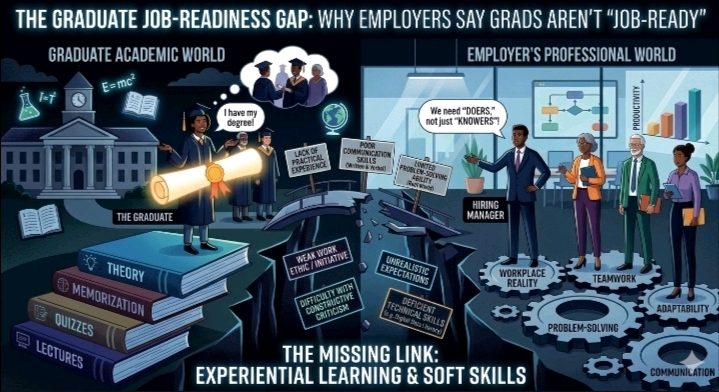
Graduate employability has become a major concern in Nigeria’s higher education discourse. Despite rising numbers of university graduates each year, employers across sectors continue to express dissatisfaction with the level of job readiness among young job seekers. This mismatch raises important questions about what universities are producing and what the labour market actually requires.
At the center of the issue is a persistent skills gap. While many graduates possess academic certificates, a significant number struggle with basic workplace competencies such as effective communication, teamwork, problem-solving, and adaptability. Employer feedback trends reflected in recruitment reports, including those by organizations such as PwC and ManpowerGroup global skills surveys, consistently show that soft skills are often as important as technical knowledge. In Nigeria, recruiters frequently observe that applicants fail interviews not because they lack degrees, but because they struggle to express ideas clearly or demonstrate practical understanding of workplace tasks.
Several factors contribute to this gap. A major one is the heavy emphasis on theoretical learning in many Nigerian universities. Teaching often prioritizes lectures and examinations over practical engagement, internships, or industry-based exposure. In addition, limited collaboration between universities and industries reduces students’ access to real workplace environments. Communication training is also frequently treated as a general course requirement rather than a core professional skill integrated across disciplines. Economic constraints further worsen the situation, as underfunded institutions struggle to provide modern laboratories, learning facilities, and structured internship opportunities.
Responsibility for this situation is shared. Government institutions play a role through chronic underfunding of higher education and weak enforcement of curriculum modernization policies. University administrations also contribute by maintaining outdated teaching approaches that do not reflect current labour market realities. Industry stakeholders are not exempt either, as limited engagement with universities reduces opportunities to shape curriculum or support structured work placements. The result is a system where students graduate with certificates, but not necessarily with the skills required to function effectively in the workplace.
Addressing this challenge requires deliberate reform. Universities need to integrate experiential learning across all disciplines, ensuring that students engage in internships, group projects, and practical simulations before graduation. Curriculum design should prioritize communication, critical thinking, and digital literacy as core competencies rather than optional additions. Stronger partnerships between institutions and industries are also essential to expose students to real-world environments early in their academic journey. At the policy level, government investment must go beyond infrastructure to include funding for practical training, innovation hubs, and skills development programs within tertiary institutions.
The broader question remains unavoidable:
Are Nigerian universities truly preparing students for the world they are entering, or are they primarily issuing certificates for an economy that has already changed its demands? Until this gap is addressed collectively, graduate unemployment and underemployment will continue to remain persistent national concerns.
