
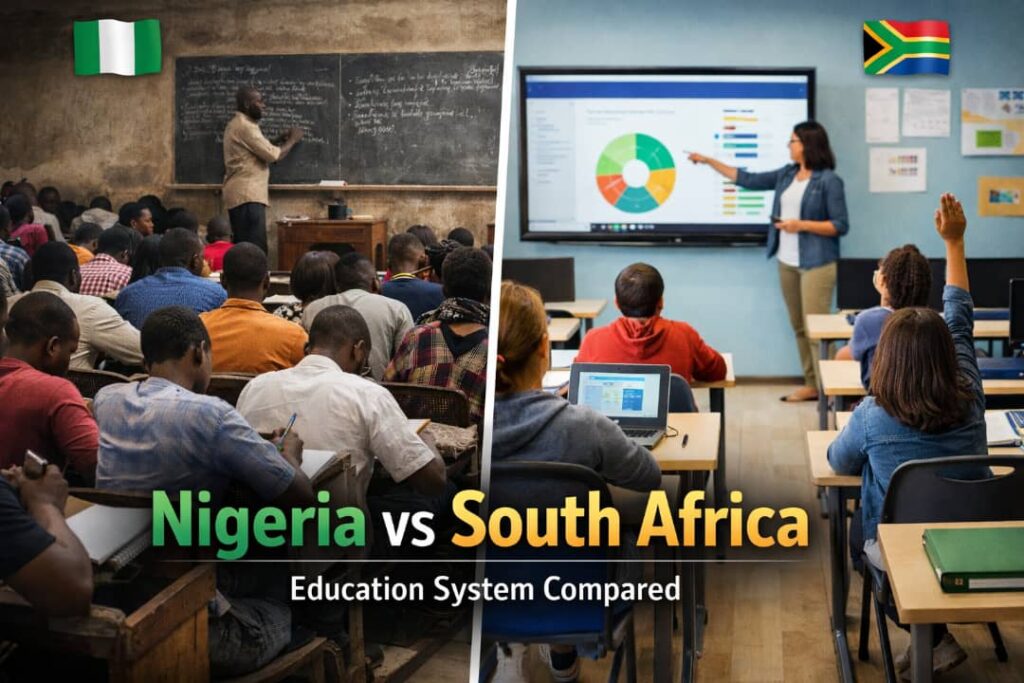
Education is key to national development. Nigeria and South Africa are two major African countries, but their educational systems differ in funding, quality, and stability
This study uses research and student opinions to compare both systems.
Findings
1. Structure
Nigeria: 6-3-3-4 system
South Africa: 9 years compulsory + 3 years + tertiary
2. Funding
Nigeria: Low funding, poor facilities
South Africa: Better funding, improved resources
3. Learning Environment
Nigeria: Strikes, overcrowding, delays
South Africa: Stable calendar, better learning conditions
4. Access to Education
Nigeria: Competitive, limited admission
South Africa: Easier and more structured access
5. Student Experience
Nigeria: Delays due to strikes
South Africa: Expensive but organized
Discussion
South Africa performs better in funding and stability, while Nigeria faces challenges with infrastructure and consistency.
6. Teacher Quality and Training
Nigeria: Inconsistent teacher training and low motivation due to poor welfare.
South Africa: More structured teacher development and better support systems.
7. Infrastructure and Facilities
Nigeria: Many schools lack basic amenities such as electricity, laboratories, and libraries.
South Africa: Schools are generally better equipped with modern classrooms and learning facilities.
While the comparison clearly shows that South Africa has an advantage in terms of funding and stability, it is important to recognize that Nigeria has a rapidly growing youth population, which presents both a challenge and an opportunity for educational expansion.
Socio-economic factors such as poverty, population size, and urban-rural disparities continue to affect Nigeria’s educational development. On the other hand, South Africa’s relatively smaller population and stronger institutional frameworks allow for more effective management of its education system.
Nigeria needs better funding and reforms to match South Africa’s educational standard.
