
AN OPINION
INTRODUCTION
Lecture attendance in Nigerian universities has been steadily declining, and this trend has become a growing concern among lecturers, school administrators, and even students themselves. For many young people, the university experience traditionally involved engaging with lecturers in person, taking notes in class, and interacting with peers. Today, however, more students are choosing to skip lectures, and the reasons behind this shift reveal deeper issues within the educational system.
CAUSES
One of the major factors contributing to declining attendance is the frequent disruption of the academic calendar. Strikes, delays, and other interruptions make it difficult for students to maintain a stable learning routine. When academic sessions are constantly stretched or paused, students often lose motivation and develop alternative study patterns that no longer depend on attending lectures. Over time, this weakens their connection to the classroom setting.
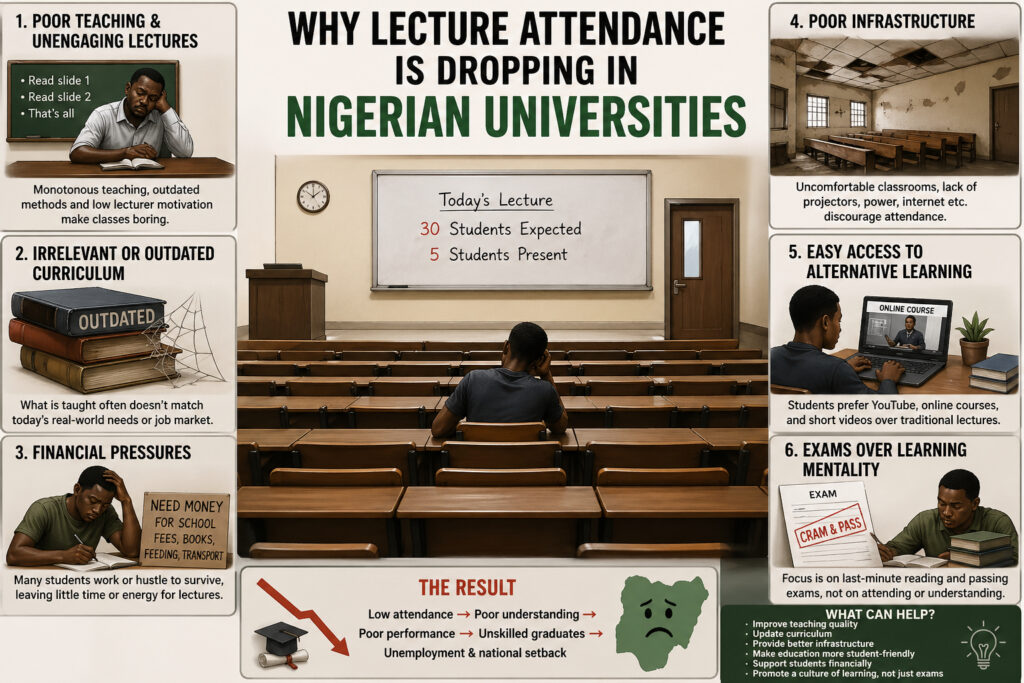
Many students are also discouraged by the physical learning environment itself. Overcrowded lecture halls, poor ventilation, broken seats, and outdated teaching equipment make attending classes uncomfortable. A lecture environment that is meant to support learning often becomes a source of stress and distraction. When students find it difficult to concentrate or even secure a seat, skipping lectures becomes an easier choice.
Economic challenges add another layer to the problem. With transportation costs rising and the general cost of living increasing, many students especially those living off-campus struggle to attend daily classes. Some students take on part-time jobs or small businesses to support themselves, leaving them with less time and energy to be physically present in class. For them, balancing survival with academic responsibilities becomes a daily struggle.
In addition to these problems, the rise of digital alternatives has made skipping lectures even more tempting. With class notes, slides, recorded lessons, and summary materials circulating online, many students feel they can keep up academically without physically being in the lecture hall. For some, accessing materials online is faster, easier, and more efficient than attending a class where the lecturer simply reads from the same slides.
The teaching methods used in some classrooms also play a role. When lectures are monotonous, unengaging, or overly theoretical, students quickly lose interest. Many complain that some lecturers provide little explanation beyond what is written in their notes. Without interactive or practical teaching styles, students feel disconnected and prefer to study on their own or rely on online platforms that explain concepts more clearly.
There is also a cultural shift happening among students. Instead of prioritizing understanding, many focus primarily on passing exams. As long as past questions and summaries are available, some students believe classroom attendance is optional. This exam-driven mindset encourages shortcuts and reduces the perceived value of attending lectures for deeper learning.
CONCLUSION
Overall, the drop in lecture attendance in Nigerian universities is a reflection of wider issues within the education system. Unstable academic schedules, uncomfortable lecture halls, rising economic pressures, unengaging teaching methods, and the easy availability of online alternatives all contribute to this growing trend. While some students manage to keep up academically without attending lectures, the quality of learning and classroom interaction is gradually diminishing.
Reversing this trend will require collaborative effort. Universities must invest in improving learning environments, stabilizing academic calendars, and encouraging modern, engaging teaching methods. Financial and technological support can also help ease students’ burdens. Above all, improving lecture attendance is not just about enforcing policies it is about restoring students’ confidence in the value of showing up, participating, and being part of a meaningful learning experience.
